
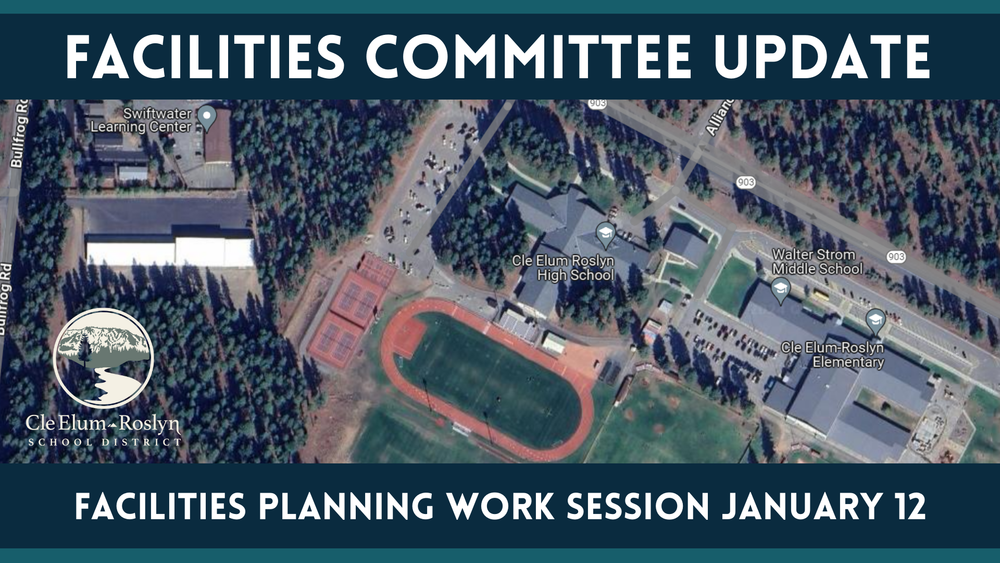
At its Nov. 10 board meeting, the Cle Elum-Roslyn School District received an updated District Master Plan from ALSC Architects, outlining the next phase of long-range facility improvements and confirming the district’s move toward a combined 7–12 secondary campus.
The updated plan builds on months of analysis following the Facilities Use Committee’s final recommendation earlier this year. The Facilities Use Committee was composed of community members, industry professionals, architectural experts, and district employees, ensuring a broad range of perspectives and expertise informed the work. Cle Elum–Roslyn School District facilities have reached a point where significant modernization and infrastructure improvements are necessary. While the district has worked diligently to maintain its buildings, many of our facilities—constructed in the 1970s and early 1990s—no longer meet the demands of modern instruction, contemporary educational programming, or the evolving needs of today’s students.
This includes supporting both a strong college-going culture and robust Career and Technical Education (CTE) pathways aligned with high-demand jobs in our region. Modern instruction increasingly requires specialized spaces—such as science labs, technical classrooms, special needs populations, physical education, and hands-on CTE labs—that support skilled trades, career exploration, and postsecondary readiness. Our current facilities are significantly out of date in meeting these growing demands, limiting the district’s ability to expand programming and provide students with learning environments aligned to future-ready skills, and competitive options to help our graduates compete in a challenging job market.
Capacity challenges further compound these issues. Elementary enrollment currently exceeds building capacity, even with the use of multiple portable classrooms, and demographic studies indicate continued growth of approximately 20–30 students per year. Aging building systems and rising utility costs further underscore the need to modernize our facilities to improve efficiency, sustainability, and functionality.
The community can also clearly see growth occurring around us. Two significant developments currently underway have the potential to add nearly 2,000 new households to the area, in addition to several other projects—including the new apartment complex being constructed adjacent to the district office and bus garage. Regional planning data indicates that Cle Elum is anticipated to be the fastest-growing city in Kittitas County over the next decade, further reinforcing the need for long-range facilities planning.
At the same time, it is important to acknowledge that the district has not made significant capital investments in its schools since the 1990s. As a result, many core building systems are reaching the end of their useful life. While the district has continued to maintain facilities as responsibly as possible, the scale of needed upgrades now extends beyond what can reasonably be addressed through annual operating budgets alone. In the event of a major or catastrophic failure of a critical system, the financial and educational impact would far exceed the district’s current capacity to respond.
Many of the improvements being considered—such as modernized learning spaces, upgraded infrastructure, and facilities aligned with college and career pathways—are intended to be proactive, cost-conscious investments that reduce long-term risk, improve efficiency, and better serve students and the community. This planning effort reflects a commitment to thoughtful financial stewardship, ensuring that future needs are addressed deliberately rather than reactively.
7–12 Campus Identified as Most Viable Option
The Master Plan reaffirms that remodeling the existing high school into a unified 7–12 campus remains the district’s most feasible and fiscally responsible option. Under this model, 6th grade would return to the elementary level, and the current middle school wing would be repurposed to expand K–6 capacity.
ALSC Architects outlined how the remodeled campus would create two distinct environments within one facility, with separated wings, separate lunch schedules, and separate program areas. The design would modernize academic, arts, and career-technical specialized spaces while reducing operational duplication and doubling costs across two separate secondary buildings.
Cost and Operational Efficiencies Highlighted
The updated financial analysis presented at a previous meeting showed significant cost differences between a combined 7–12 campus and maintaining separate 7–8 and 9–12 schools. Operating a single secondary facility is projected to require approximately $60,000 in additional staffing, largely custodial. In contrast, two standalone schools would require over $800,000 in combined staffing for custodial, food service, office support, safety/security, nursing, and additional teaching and CTE positions.
District officials emphasized that the higher-cost model would require ongoing levy support to sustain staffing not funded by the state. The 7–12 structure, they noted, reduces long-term financial risk while increasing operational flexibility and meets one of the Cle Elum School Boards foundational strategic plan goals of being fiscally responsive.
Addressing Community Concerns About Grade Configuration
During the last presentation, district leaders acknowledged community questions about placing 7th and 8th graders on the same campus as high school students. They noted that similar configurations are common across Washington and that the district already manages cross-grade interactions in middle school and elementary school in the same facility (Pre-K-8th grade), transportation, athletics, music programs, shared facilities usage, and advanced coursework.
The proposed facility design would further limit overlap by ensuring dedicated middle-school zones and age-appropriate programming. According to staff, the model preserves developmental needs while improving program alignment and access to specialized spaces, while significantly reducing costs.
Concept Images Show Possibilities, Not Final Design
ALSC Architects emphasized that the visual materials shared previously are conceptual and intended only to illustrate how independent and shared spaces could be arranged within a future 7–12 building. A final design will be created after the district completes its programming analysis, which is currently underway with staff and consultants to determine the educational spaces and instructional models needed for the next three decades.
Next Steps
The district will continue refining the Master Plan over the coming months, incorporating updated cost estimates, space requirements, and, most importantly, community feedback. No decisions have been made by the Board at this time, and community insight remains a critical part of the process as we consider how best to plan for the future of our schools.
 An important opportunity for public engagement is coming up this Monday, January 12, at 6:00 p.m. in the Central Office Board Room (4244 Bullfrog Road, Cle Elum, WA 98922), during a scheduled Board work session. At this meeting, the Board will hear from the district’s programming consultant and architectural team regarding Career and Technical Education (CTE) programming updates and the results of the Educational Specifications process. This phase represents the culmination of months of collaboration with district staff, translating instructional needs and program goals into the types of learning spaces required to support students over the next 30–50 years.
This work session is an informal meeting where no formal decisions will be made. Community members are encouraged to attend, listen, and share their perspectives on what is presented. We value stakeholder voices and look forward to continuing this conversation together as we thoughtfully plan for the future of Cle Elum–Roslyn schools. Additional opportunities for public input will be announced as the design and planning work progresses.
More information and ongoing updates are available on the district’s Facilities Use Committee webpage.